Hello world!
Welcome to WordPress. This is your first post. Edit or delete it, then start writing!

Welcome to WordPress. This is your first post. Edit or delete it, then start writing!
A nomadic existence
Philip Gain | News Link
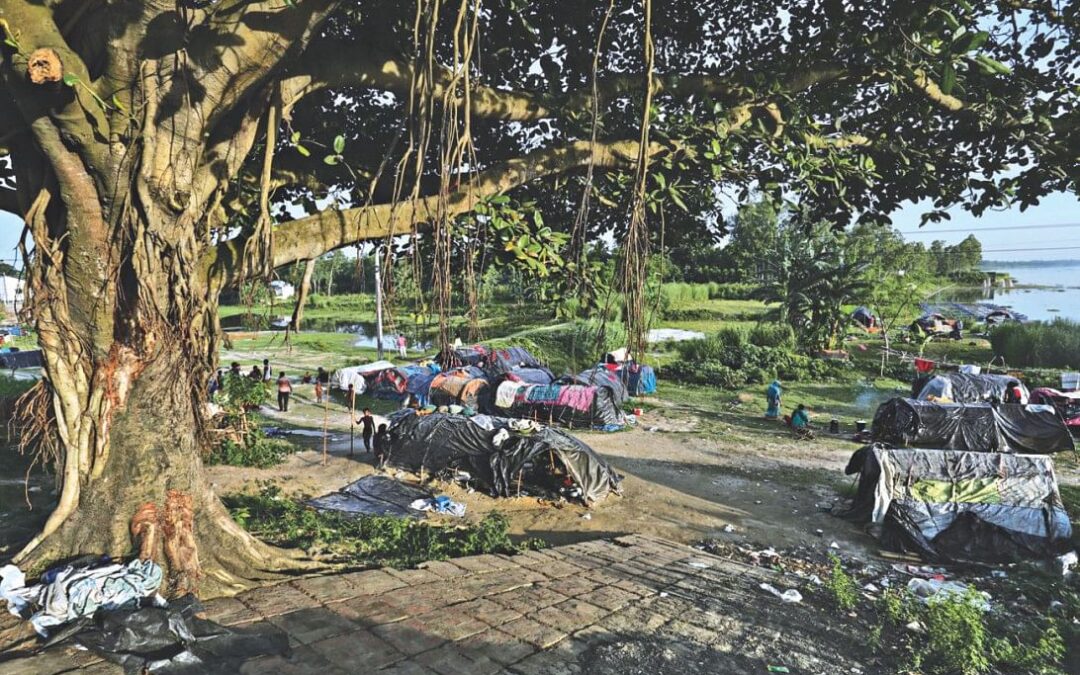
14 Bede families have set up their oval-shaped makeshift tents on private land in Natun Torki, a village in Kalkini Upazila of Madaripur district. A branch of the Arialkha river flows on the west of Natun Torki. The area is well-known in Barishal for Torki Bandar, a narrow but flowing river on the west. The Bede huts are just on the outskirts of the crowded Natun Torki market.
Soud Khan, a Bede Sardar from Kharia in Munshiganj, and two other Bedes—Md Zakir Hossain and Md Nurun Nabi—guide me into their tents, many in the open space and some under the shade of a tree. It is a bright, sunny afternoon in June 29, 2018. Each tent seems to have everything a family needs, all crammed into a 100 to 150 square-feet space. Most tents are also fitted with solar panels. The tents facing west glow in the golden sunshine.
It is Friday, an off-day here. I inspect the tents and take photos in the daylight before finally sitting down for a chat with the elderly Bedes, surrounded by everyone of the little Bede community.
Md Zakir Hossain, in his late forties, informs me that all 14 families there had started their journey from Khari in Munshiganj in October 2017. Since then they have set up their tents and set up businesses in 14 places!
Their journey through these months saw them moving through Shariatpur, Madaripur, Barguna, Jhalakathi and Barishal. Before coming to Natun Torki, they spent a month and ten days in the Doari Bridge area in Barishal.
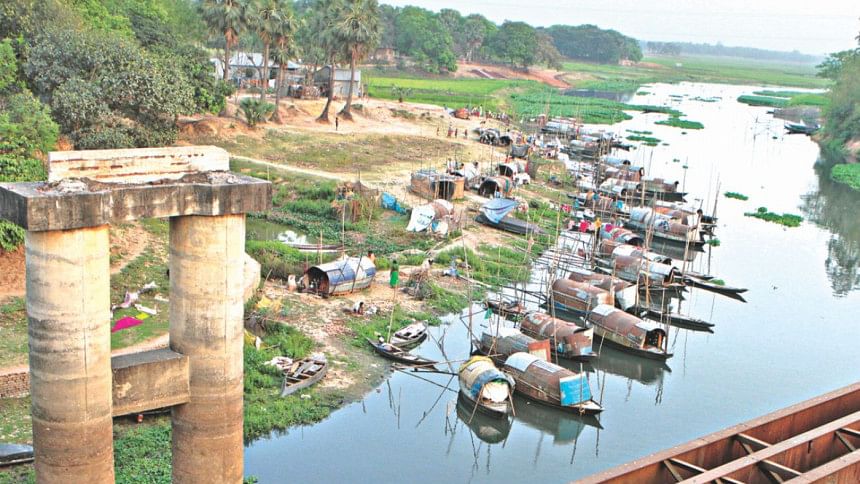
“We stay in an area for as long as the business is good,” says Hossain, admitting that the business is actually not that good anywhere. “We survive on minimal income and the scope of business dries out pretty quickly. So, we keep moving.”
The 14 families are all Mal Manta, one of a dozen groups among the Bede. One main business of the female Mal Bede is making use of singe, a metal pipe that sucks out bad blood from the human body to give relief from pain. Other businesses of Mal Bede include the search of lost gold, and sale of imitation ornaments, cosmetics, amulets, cups and other light utensils.
Hossain and his group plan to stay at Natun Torki for no longer than two weeks. They do not think business will be good here. I call Hossain some 20 days after I meet them to check if they have moved on.
“Yes, we are now at Haturia Launch Ghat in Goshairhat Thana under Shariatpur district,” he tells me. “We stayed at Natun Torki for 15 days.”
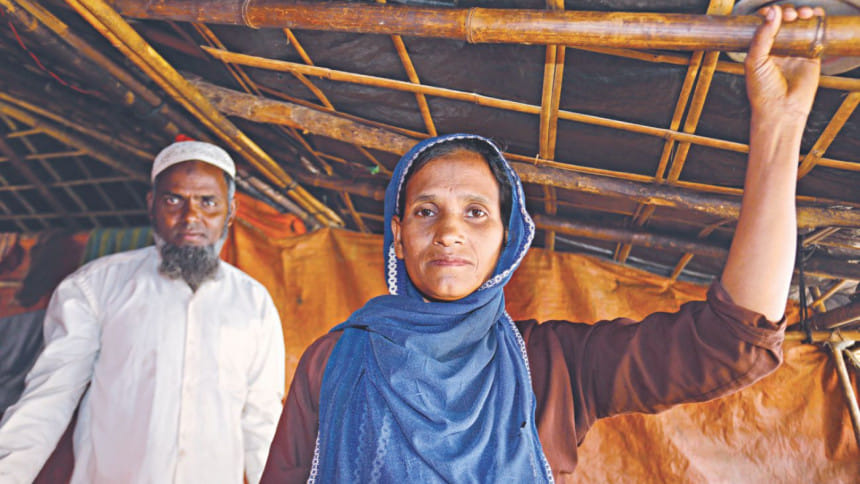
The life of the Bedes is tough indeed. “Because we are always on the run, our children cannot attend school,” laments Rubina Akhtar, 45, explaining that none of the 25 children of the 14 families receive education.
“Many years back, Father Renato, a Catholic priest, used to assist us and had a school that would travel with us,” recalls Rubina’s husband Nurun Nabi, 55, who had been a teacher of the floating school. Nurun Nabi studied up to class ten and is ready to teach the Bede children again.
“Give us a school and a teacher,” Rubina demands of me repeatedly. “We want education for our children.” When I mention that Bangladesh reportedly has a 100 percent enrollment for children, Rubina shouts in disagreement, “It is a lie.”
A large percentage of the Bede is on the move like these 14 families; and their children do not get any education. About 15 years ago, these groups used to glide through the country in boats. Their economic condition was better back then. Now, none them have a boat.
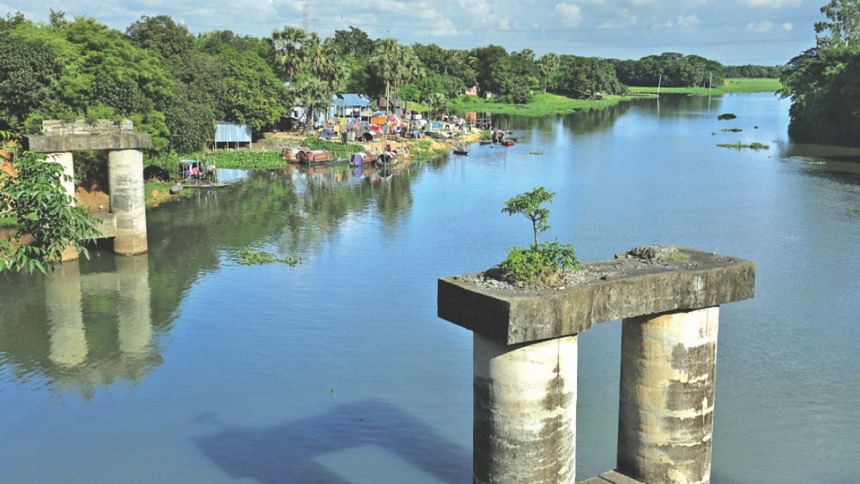 Most of the Bede boats in Kakalia disappears in 2018. Photo: Philip Gain
Grambangla Unnayan Committee, a non-profit organisation that works closely with Bedes, estimates that there are 5,000 Bede groups roaming around the country for 10 months around the year. Then they assemble at 75 locations in 39 districts. Normally, they get together during Eid-ul-Azha or national and local elections. Most of them were not allowed to vote until 2007.However, a great percentage of Bede households do not have land or houses where they are registered as voters. They simply carry their tents everywhere.
According to a survey by the NGO, more than 90 percent of Bedes are illiterate. An overwhelming percentage live below the poverty line. Very few children are vaccinated. As they change locations often, they do not enjoy any government family welfare schemes or health assistance. Although they belong to the poorest of the poor and are landless, they hardly get khas land for settlement. Their access to safety net programmes such as old age allowance, VGF cards, disability allowance, flood relief etc. is minimal.
 House of a poor Bede in Torki, Barishal. Photo: Philip Gain
Before visiting Natun Torki, we also spend hours at Torki Char Bede Palli. The hamlet is located along a half kilometer stretch on a western branch of the Arialkha river that snakes through Torki Bandar. The Bede hamlet, with its two-storey concrete and wooden houses, is neat and clean. Some houses, of course, reveal the poverty of the 60 families staying there. The shabbier houses are built like boats on plinths, perhaps in fond memory of their long-lost boats. The differences between the well-off and poorer Bede are clearly visible.
Md Nannu Sarder tells me that in addition to the 60 families settled on tiny plots of land purchased as far back as 25 years ago, another 60 to 70 families assembled here on boats for two months in October. Torki Char Bazar is home for them. Some families have small plots of land but they are yet to build houses.
For a month or two in October and November they relax, organise parties with singing and dancing, repair their boats, and settle social matters such as disputes and marriages. “About half of the 70 families who don’t own houses and have their boats under repair set up tents,” explains the Sardar (leader of the Bede hamlet). The hamlet grows lively with the assembled crowds.
But during business season, most working men and women go out to sell their business ware. Some women roam around with singe leaving the hamlet nearly empty. Beside the village, the river flows quietly—lifeblood of the wandering people, eager to settle down as agriculturists.
“But we have been able to purchase only tiny plots of land on which to build our houses,” says Nannu Sarder, his strong features not once reveal his age of 75. “None of us have agricultural land.”
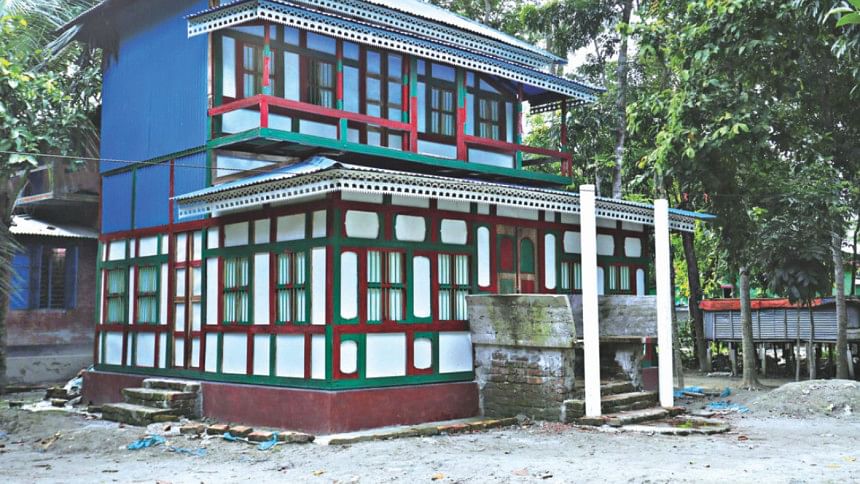
A two-storied typical house of a well-to-do bede in Torki, Barishal. Photo: Philip Gain
This is a change they want now. “Once we settle down, our children can go to school,” asserts Nannu.
Two of Sarder’s friends—Md Jahangir and Md Abdur Rab—join us as we chat. They reminisce about their life 25 years back, when they all had boats. “We used to come here twice a year since 1972. The river had a magnetic power. We would repair our boats here,” recalls Md Jahangir, 65, who was the first to buy five decimals of land for Tk 40,000 back in the day.
“The local Gale (non-Bede Bangalee) offered to sell land to us,” says Md Jahangir. Others followed Jahangir too.
The Manta of Torki Char Bede Palli in Gournadi Pourashava are all from Amanatganj, Barishal, and all are Muslims. They believe that they are different from Bedes of Dhaka Division and other areas. Soud Khan of Kharia in Munshiganj who accompanied us agrees. “I can see the Bede of Barishal are the homely kind,” observes Khan.
The benefit of a permanent address is clear.
However, even after settling down, they face social difficulties with the Gale. “They look down upon us and do not want to socialise with us,” says Nannu Sarder. “We pray in separate mosques and we do not mix with the Gale who envy our economic well-being.” Relations between the Bede and Gale turned bitter after a fight two years ago.
Like the Bede who have settled in the Torki Bandar area, other Bede groups are also trying to settle on land. One such group is seen in Kakalia village in the Nagari union of Kaliganj upazila in Gazipur. Even a year and half ago, around 60 Bedes had boats beautifully lined up in the Turag river close to the Tongi-Ghorashal Highway. At one time, 200 boats would float in this part of the Turag, serving as a reminder of the river gypsy tradition in riverine Bengal.
But in July 2018, only eight boats were left. Quite a few of the awnings were set on the land close to the river. Others have disappeared from the river with signs of dilapidation around. Around 60 families have now built their houses on khas land on the Turag bank. The majority of the families have built tin shed houses, some with concrete floor. One family has constructed a two-storey home with a wooden deck—a typical house of a well-off Bede family. Others have set the awnings of their boats right on the banks of Turag.

Child being prepared for marriage. Photo: Philip Gain
Mosammat Rezia, 70, born and brought up on a boat, feels sad about the boat life that has recently ended for her and others. She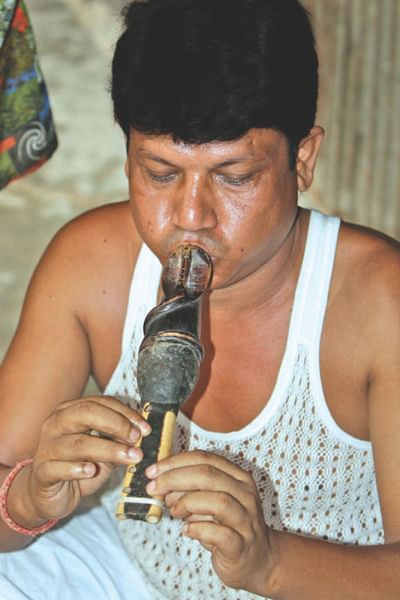 has sold cosmetics and ornaments on foot all her life, a typical mode of work for Sandar Manta women. She has two sons who sell cosmetics and supplement their income by fishing in the Belai beel and river during monsoon.
“We are destitute,” sighs Rezia. “We have to buy everything except for water.” The families, however, have received two concrete toilets and one tubewell from the government.”
Land and agriculture are mirages to the Bede of Kakalia or elsewhere. 60 Bede families have settled on 51 decimals of khas land; but not for free. Abu Miah, Tabu Miah and Ali have taken yearly leases of 20 decimals of land and divided it into 10 tiny plots. Fazlul Haque, Rezia’s son, took one of the plots for BDT 8,000 15 years ago. Others have taken plots for between BDT 40,000 and BDT 50,000.
It is here that we find Nuru Miah, aged 110. He stoops low, yet he walks fast and his eyesight is perfect. Born in Demra, he came here 10 years back. His wife Gedi Begum is 90 years old. Both husband and wife were born, and have spent all their life, on boats.
A Bede playing been or pungi (flute). Photo: Philip Gain
“Since then we have set the awnings of our boat on land and we live under it,” he says, pointing to the oval-shaped structure that he set up after his boat broke. Everybody in the little hamlet is sympathetic to the aged couple.
A few families in Kakalia that still live there will soon abandon their boats. “We do not want to go back,” says Sadhina Begum, 47, who with a son and two daughters left their boat about a year back.
Sadhina’s son works at a garment factory at College Gate, 10 minutes away from Kakalia. Like Sadhina’s son, 15 other young boys and girls go to work in the nearby garment factory.
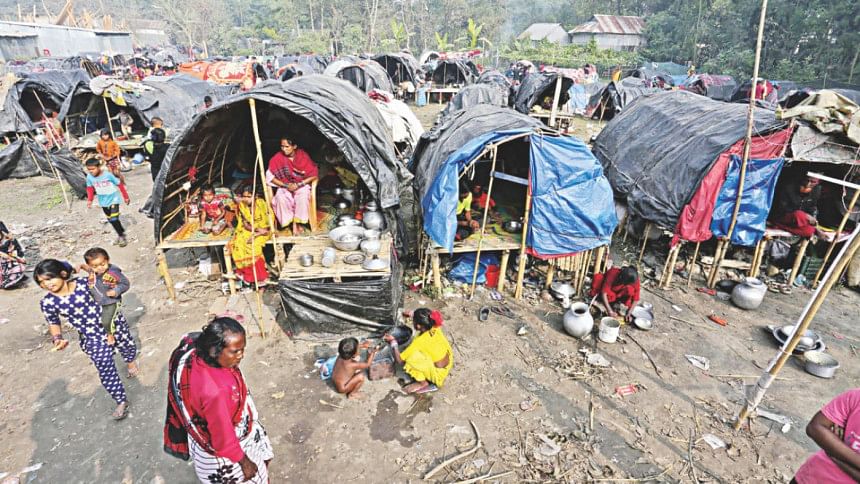
Bede tents in a playground in Goalimandra, Munshiganj. Photo: Philip Gain
A much bigger group of Sandar Bede, around 320 families, have been living on the Turag bank attached to the Tongi bridge. It is actually an age-old Bede slum comprising small huts crammed on a narrow strip of public land.
The men of this Bede squalid are in the fish trade. They buy fish from Abdullahpur, Jatrabari, Karwan Bazar, etc and sell it in the local market. “The Turag was wider and clearer in the past,” says octogenarian Ismail, “but now it is too polluted with hardly any fish to catch.” The women, as usual, sell cosmetics and utensils in villages far and near.
Bedana, aged 70, sits in front of her hut in great despair. She has heard that many of the Bede houses would have to be dismantled for the construction of another bridge in Tongi. “We have no land and no means. We do not know where to go if we are required to move out,” says Bedana.
When I checked with Giashuddin Sarker, councillor of Ward No. 57, Gazipur City Corporation, in late September last year, he reported that, “94 Bede families have already been evicted for Tongi bridge construction. They have taken shelter in their relatives’ houses and a few families have gone to Savar Bede villages.”
Other Sandars at Tongi are equally concerned. In fact, this has Bedes all around the country concerned. They want change in their lifestyles. They want to settle on land and become agriculturists. It is a century-old desire as reflected in W.W. Hunter’s writing on Bediyas around a century and half ago: “They mostly wander about in boats, and subsist by jugglery and thieving, but some of them have now settled down as agriculturists.”
However, Bede life on land is not easy. Unemployment and social ills such as drug addiction thrived in Bede villages. But years back, things began to improve with the help of a police officer, Habibur Rahman, then a superintendent police of Dhaka and now a deputy inspector general of police.
The police official appeared as a great friend to the Bede. “He motivated the drug addicts and dealers in the villages to engage in productive work,” says Ramjan Ahmed, an educated Bede leader from Badda and managing director of Uttaran Fashion, a small garment factory that exclusively employs Bede girls and boys. “Many girls who previously charmed snakes and sold cosmetics now operate modern sewing machines and make clothes for export.”
The factory is also a training ground. “So far 105 girls and boys have been trained and about 50 of them work at the factory,” states Ramjan Ahmed. “The factory keeps training girls with a financial incentive. They seek work in other factories after learning the skills of the trade. This is how many are transitioning from traditional work to modern-day work.”
Bede girls from Munshiganj photographed in Torki Bandar, Barishal. Photo: Philip Gain
“The profits are spent on the welfare of the Bedes,” says Habibur Rahman, who has a comprehensive plan for the Bedes of Savar in particular. A primary school dedicated for the Bede children is months away. A cluster village on about four acres of land for the landless Bede is becoming visible on the other side of the Bongshi river, which was the life blood of the Bede not long ago.
With Habibur Rahman’s initiative, 36 young people have learned to drive. Many others have passed the test to become police officers and got other jobs. He set up four schools in Khari in Munshiganj, and also helps when Bedes face trouble anywhere in the country.
“I also want to set up a Bede museum in Savar where people will see the Bede artefacts and learn about their history,” says Habibur Rahman with confidence.
The Bedes are clear enough on one thing: they are falling behind in the race for progress. They realise if their nomadic existence continues, they cannot send their children to schools, access public health services and attain skills to move out of extreme poverty. So, their appeal to the state is that they are permanently allocated some khas land or that arrangements are made so that they can purchase small plots in areas they feel comfortable to live in.
Philip Gain is researcher and director of Society for Environment and Human Development (SEHD).
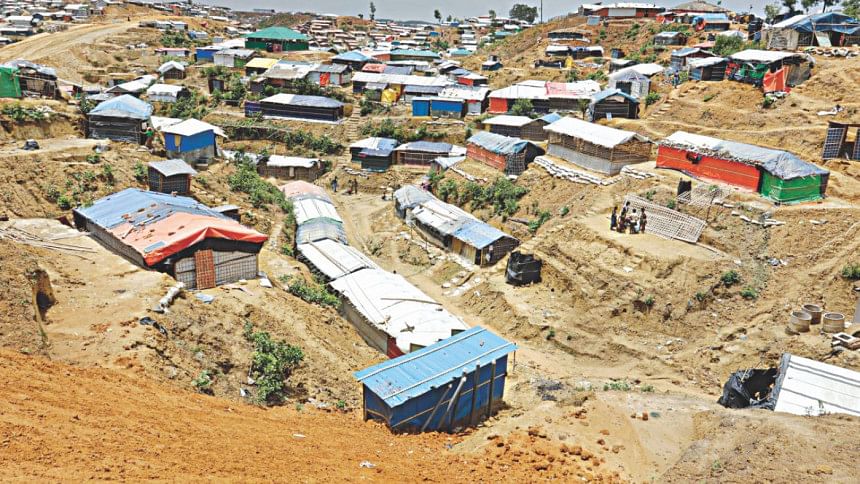
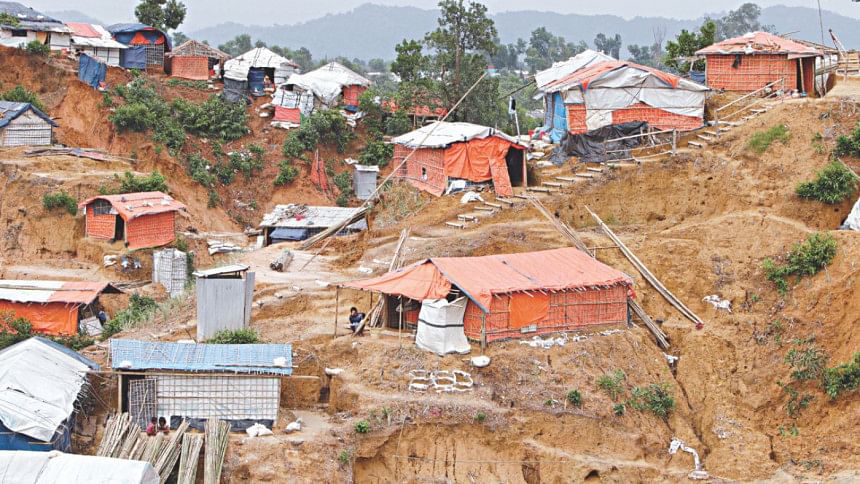
We stand in the middle of Rohingya Camp No. 18. It is in the southwest of Kutupalong Rohingya camp cluster in Ukhia upazila of Cox’s Bazar district. We are stunned. What used to be green hills months ago are completely devoid of vegetation today and covered with tens of thousands of flimsy shelters made of bamboo, polythene, and tarpaulin of different colours. There is hardly any empty space in the hills occupied by the Rohingya.
The hills in the 5,800 acres of forestland (as of early this year) have not only been stripped off of vegetation—natural or planted—they have been thoroughly downsized. Some have been levelled and many partially cut out for construction of roads. Red, sandy mud is piled here and there. The temporary shelters have been built on the terraced hills from top to bottom.
The biggest refugee camp in the world today—Kutupalong—has been split into 24 smaller camps and each camp is designated a number. Of the total 32 camps, other eight camps are scattered in Teknaf upazila.
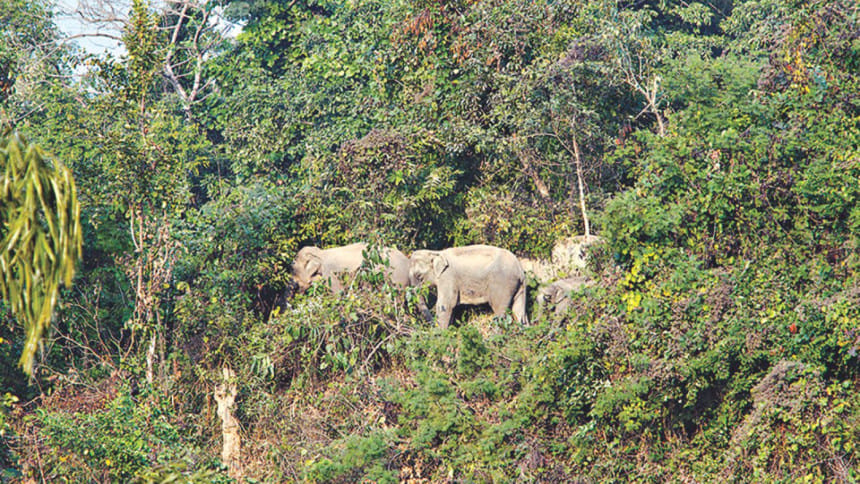
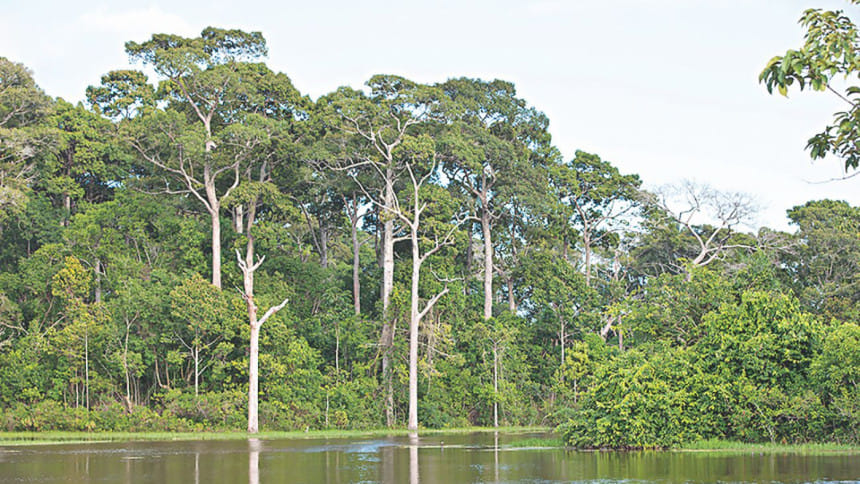
The landscape that was once filled with songs of birds and crickets and roamed around by elephants and a myriad other wild creatures is thoroughly degraded today. Every inch is now occupied by humans. During the daytime, a low clamour can be heard everywhere and the Muslim call for prayer ring out from the mics of the mosques at intervals.
On May 19 this year, when we stood in the completely ruined forest landscape, we stopped Giasuddin, a young man from Balukhali (a village east of Camp No. 18) to hear how he as a local felt about the abrupt change in his neighbourhood.
“The entire area was jungle with acacia plantation. This is elephant territory,” says Giasuddin with confidence. “I have seen tigers, elephants, and other animals in this area. The jungle was there until Rohingya poured in.”

Monjur Alam, a 31-year-old-Rohingya of Balukhali camp, agrees with Giasuddin. “When we came here nine months ago, it was all good jungle. I myself cut 10 to 12 trees to make space for my house. I saw an elephant the day I came here. The elephant killed two persons of a family,” says Alam. “We used to go to the jungle to collect firewood. But when the rain started, we stopped going there out of fear of elephants and leeches.”
When the Rohingya, in the face of genocide in their own country, had begun to come into Bangladesh from August 25, 2017 onwards, everybody was shocked. The Rohingya influx, with nearly 120,000 people crossing the border per week at its peak, was the highest since the Rwandan genocide (according to an estimate by The Economist).
The land where the Rohingya camps were built was covered with greenery and was under the jurisdiction of Bangladesh Forest Department (FD). The FD officials tried to prevent the Rohingya from occupying the forestland. They did not anticipate then, the sheer number of people that were yet to come. “We were in the field for little over a week since August 25 to resist. But the Rohingya influx since Eid-day (September 5, 2017) was so great that we gave up. We had no time for planning. Our main purpose was to protect people,” says Md. Ali Kabir, the Divisional Forest Officer of Cox’s Bazar South Forest Division.

The initial days of the Rohingya influx were traumatic for the Forest Department and they watched helplessly as the Rohingya people settled in the forest land in Cox’s Bazar.
What is unique about the district of Cox’s Bazar is that officially 38 percent of its land surface is forestland and in the upazila of Ukhia alone, it is more than 50 percent. According to the office of the Cox’s Bazar South Forest Division, the state of the forest was already perilous even before the Rohingya influx in 2017-2018. Many of the 1991 cyclone victims took refuge on the forest land here in Cox’s Bazar. Development activities required cutting down parts of the forest even before. One example is land acquisition for building a cantonment and construction of the marine drive from Cox’s Bazar to Teknaf. The soil required for the marine drive was actually mined from the hills. The Forest Department did not approve of it but they were allegedly rendered powerless in the face of an ambition such as the marine drive, which after completion, is apparently very pleasing to tourists. But very few are aware of the environmental costs behind it.
The Forest Department also had to give up land for development of Cox’s Bazar town and tourism facilities that the government has been promoting. Meanwhile, the monoculture of foreign species, especially acacia and eucalyptus, has replaced garjan forests, creating a man-made disaster on pristine forest land.
Nevertheless, what happened to the forests of Cox’s Bazar since the beginning of the current influx has been nothing less than a catastrophe.

Teknaf Wildlife Sanctuary, the only game reserve of the country up until 2010, is just on the south-western border of Kutupalong Camp. The wildlife sanctuary started with 28,688 acres of forest land. According to the Forest Department, some 800 makeshift shelters have been erected in the sanctuary area, which is not that high a number yet, believes FD. “But the Rohingya who had started exploiting the sanctuary from the very beginning of their arrival are grave concerns for the forest and local communities,” says an official.
The destruction of the forest is not just about clearing of trees. The number of plant species and wildlife in and around the camp sites are in danger of being drastically reduced, if not completely wiped out.
According to the office of Cox’s Bazar South Forest Division, Teknaf Wildlife Sanctuary alone contained 50 percent of all the mammals found in Bangladesh not too long ago, including the rare Malayan tree shrew and eight of the 10 types of primates found in the country: leopard, golden cat, fishing cat, jungle cat, hedgehog, fox, wild boar, monkey, langur, great hornbill, big grey wood peckers, and Asian elephants. Around 112 different plant species including garjan and evergreen trees and other secondary plant species grew in these hilly areas. Around 64 faunal species with high populations of 10 species of mammals, 40 species of birds, 10 species of reptiles and four species of amphibians were recorded in the sanctuary.
Sadly, the population of the elephants in the Teknaf Wildlife Sanctuary, considered genetically viable, has now been separated into two groups—35 to 40 elephants are reportedly trapped in the west side of the Kutupalong camp and an equal number on the east. They cannot meet each other owing to the camps closing down the corridor they use for migration. This may prove fatal for the overall population in the future.
The male elephants may not take it easy and they may lose their temper and get violent, says Professor Monirul H Khan of Jahangirnagar University’s zoology department. He is also a wildlife photographer.
“The elephants travel a lot for feeding. The same herd of elephants uses the same corridor for generations,” says Khan.
That elephants may lose temper has already been demonstrated. “It happened seven months ago when a big elephant forayed into our house at 12:30 am. We were asleep. The elephant smashed our house. It killed my two children, four-month-old Yasmin Ara and six-year-old Mujibur Rahman. The elephant stepped on my hip and crushed it. I was given primary treatment at Kutupalong Hospital and afterwards, I took treatment at Malumghat Hospital for a month,” says Nurjahan, 45, propped against the bamboo walls of her makeshift hut in the Balukhali campsite.
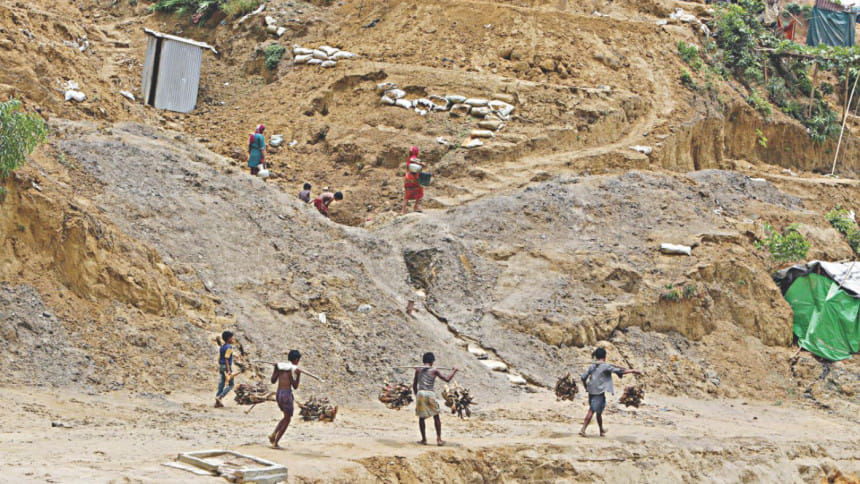
Nurjahan cannot walk normally and cannot go out of her house any longer. When we went to see her on June 15, she could only stand using the bamboo pillars of her hut for support. The camps in Balukhali and Jamtoli areas are close to Teknaf Wildlife Sanctuary area.
Nurjahan’s two children are among a dozen people killed by elephants.
The corridor for elephants that travel up to Teknaf Wildlife Sanctuary from the east has been severely disturbed by the freshly-built Rohingya shelters that currently host a population next to the third largest populated city in Bangladesh. Kutupalong Refugee Camp is not a city but some jokingly refer to it as the fourth largest city of the country.
A new emergency
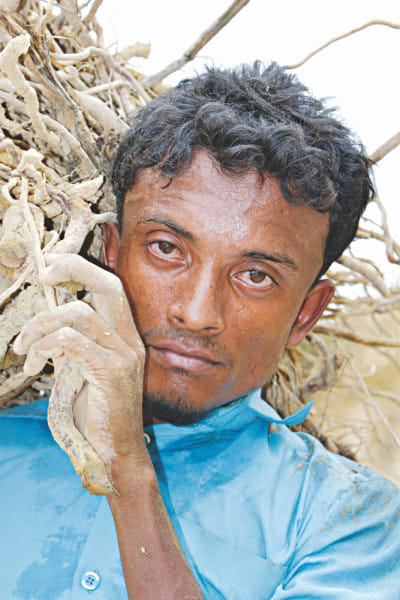
The entire population of Ukhia and Teknaf (471,768 according to 2011 census) are largely dependent on firewood for cooking their daily meals. They were heavily dependent on nearby forest land for firewood. Now a million Rohingya have been added to this population, thus increasing the demand for firewood.
“Massive deforestation has been taking place. Forests equivalent to three to four football fields are being cleared every day,” adds Paul Quigley, energy specialist of UNHCR in Cox’s Bazar, “They cannot cook their meals if they do not collect firewood.”
The Rohingya first cut down every standing tree in the camp sites (however, there was no traditional garjan to cut; those had already gone). They cut young planted trees, most of them exotic. Then they uprooted the stumps and roots. Everyday Rohingya men are seen arriving with loads of firewood, including stumps and roots of trees.
The current Rohingya influx has significantly affected local communities and their environment. “The host communities—350,000 people living close to the camps—have been directly affected,” says Subrata Kumar Chakrabarty, livelihoods officer of UNHCR. “People of the host communities have lost crops.”
The loss of forest and presence of such a large Rohingya population in Ukhia in particular has been disturbing for the ‘host’, community. “We, the villagers used to graze our animals in the forest, fish in the creeks and small lakes, collect firewood and could roam around the area freely. Now without the forest, there is no grazing land for our cows and goats and we have no access to the area,” laments Giasuddin.
The environmental effects of the Rohingya go far beyond Ukhia as well. Bamboo supplied to the Rohingya for construction of their shelters comes in large quantities mainly from the Chittagong Hill Tracts (CHT). Ora, mitinga, muli, bariwala (large)—all sorts of bamboo are being cut in excess and sent to the Rohingya camps. This has a negative effect on the environment in the CHT that has already lost much of its glory associated with its bamboo resources.
The loss of top soil in the hills that shelter the Rohingya people is obvious. This intensifies the fear of landslides in the camp sites that have some similarities with the landscapes of the Chittagong Hill Tracts (CHT). This year landslides have not been a serious issue in the camp site yet, but the risk remains as most of the land has been turned barren increasing the likelihood of landslides.
Simultaneously, huge quantities of synthetic materials such as polythene, plastic and tarpaulin are being used to create shelters for the Rohingya people. And irresponsibly disposing plastic and other non-biodegradable items will be detrimental to the future composition of the area’s soil.
Pollution in the form of light, noise, water and air are other severe causes for concern. Artificial light from the camps disrupts the nocturnal activities within the forests and so hinders wildlife reproduction ultimately affecting the species’ population. Noise from within the communities, vehicles moving in the camp site and service providers having suddenly increased further creates disturbances for wildlife in the surrounding areas.
Other serious concerns are related to WASH (Water, Sanitation, and Hygiene). Drinkable water is short in supply in Cox’s Bazar, especially in the Teknaf upazila. Therefore, access to drinking water has become even scarcer mainly in these upazilas where the refugees have settled. This will affect both the host community and the refugees, especially during the dry season.
The government is struggling to contain the water and air-borne diseases carried by Rohingya who had limited access to vaccinations and healthcare in their country. Diseases like diphtheria, respiratory tract infection, diarrhoea, dysentery, and skin diseases are very common in the camps, which may cause an outbreak beyond the camp, putting the host communities at high risk.
The latrines in the camps were built on an emergency basis when the massive Rohingya influx began in August last year. Many of the latrines are built too close to the shelters, on steep slopes, and close to canals and creeks, which are not easily accessible. Over 48,000 emergency pit latrines were installed, out of which an estimated 17 percent are now non-functional (Joint Response Plan Report 2018).
Finding a fix to environmental damages done to Ukhia and Teknaf before and after the Rohingya influx may prove extremely difficult, if not impossible, unless drastic measures are taken. For finding a long-term fix to this crisis, the Rohingya refugees should not be used as scapegoats. They are a people who have lost all their possessions back home in Myanmar and are struggling simply to survive in the camps. But in the past, in addition to plantation of exotic species, organised gangs allegedly in collusion with the Forest Department did severe harm to traditional garjan forest and used the Rohingya as scapegoats.
Currently what is needed is a rapid halt to the use of firewood for cooking purposes. The best alternative is bottled Liquid Petroleum Gas. As of early June, of this year, only 25,000 refugee families had been using it, informed the UNHCR energy expert Paul Quigley, who spoke to these writers on June 12, 2018. Borrowed from other mass refugee crises, it proves to be the cleanest and safest option. With its low emission rates LPG is the most efficient source of energy that is widely available in Bangladesh. “Companies supplying it are confident that they can bring 200,000 bottles in the camps,” says Paul.
The top soil in the hills with shelters is completely exposed, which should be covered as fast as possible. “We are planning to plant trees and encourage the Rohingya to grow vegetables,” says the UNHCR energy expert. The Forest Department also advises that the organisations and agencies (state and non-state) helping the Rohingya should consider making tree planting a regular activity in their efforts. “The Rohingya must be stopped from further expanding their territory into forest land,” says a top Forest Department official in Cox’s Bazar. “However, the FD is helplessly watching Rohingya trespassing.”
It is imperative to focus on neutral and specific research in the matter to be able to take the right policy decisions and actions to combat further environmental degradation.
Philip Gain is researcher and director of Society for Environment and Human Development (SEHD). He has been reporting, writing, and filming on environment for three decades. The writer acknowledges the contribution of Sabrina Miti Gain and Antarah Zaima Rahim in writing this report.
Philip Gain | News Link
PHOTO: Mariusz Kluzniak/Flickr
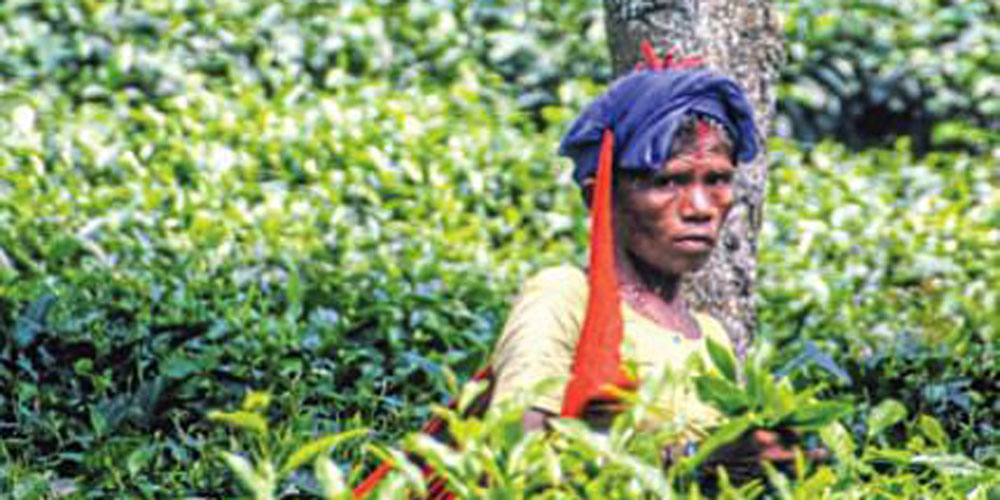
Election of Bangladesh Cha Sramik Union (BCSU) on June 24 was a joyous occasion for tea workers. BCSU happens to be the largest trade union in Bangladesh. And it is the only union for the 97,646 voters who are all registered workers in 161 tea gardens in Sylhet, Maulvibazar, Habiganj, Chattogram and Rangamati Hill District. The recent election was the third time since 1948 that the impoverished tea workers had voted for their leaders.
The first time they were allowed to vote by secret ballot was in 2008. At the time the daily pay of a tea worker was only Tk 32.50. The second election took place on August 10, 2014 when the daily pay had risen to Tk 65. In both elections, Rambhajan Kairi and Makhonlal Karmokar’s panels had won landslide victories. To no one’s surprise the results this time were the same.
Like in the past two elections, the Department of Labour (DL)—a state agency—conducted the election with an election commission headed by Shib Nath Roy, Director General (additional secretary) of DL under the Ministry of Labour and Employment. And the elections were carried out very well.
Tea workers seemed to be in high spirit on election day. Nearly 97 percent of voters showed up to vote and had no problem electing their candidates of panchayets, seven valley committees and the central committee of BCSU.
The central committee of BCSU is composed of 35 members—eight directly elected (president’s and general secretary’s panels) by voters, 22 presidents, vice-presidents, secretaries and organising secretary (only of Balishira Valley) from seven valleys (two from Balisira considering its large size compared to others), and five nominated by the losing panels of president (three) and secretary (two).
Rambhajan Kairi, elected general secretary for the third time, is happy about the elections. He was at the forefront of a youth-led campaign against Rajendraprasad Bunarjee and allegedly a central committee of his choice who controlled BCSU and its central office located in the Labour House from 1970 to 2006. No democratic elections were held during this time. “The tea workers have voted three times in BCSU and in support of our ongoing struggle for rights,” said Kairi.
Why is the government in a trade union election?
The Labour Law of 2006 considers the tea industry as a group of establishments and allows tea workers to unionise only at the national level. To form a union in the tea industry, 30 percent of the total workers must be members. Now that all registered workers have been made members of the lone union, it is unlikely for there to be a second trade union in the tea industry should the current situation persist.
What is most appalling is that BCSU remains isolated from unions, federations or confederations outside the tea industry.
“There is no precedence in recent history of the government conducting an election of a trade union in any other industry with funding support,” said Tapan Dutta, president of Trade Union Center in Chattogram and a close associate with BCSU.
Rambhajan Kairi, the winner has his contention: “The government has conducted our elections because we still have not developed our capacity to conduct elections of such a large union.”
Syed Sultan Uddin Ahmed, a trade union expert and Executive Director of Bangladesh Institute of Law and Labour Studies (BILS) believes that given the conflicting situation in the tea gardens, the government may come forward to assist. “But I do not know if the government has conducted election of a trade union in any other industry with funding support,” frowns Ahmed. He suggests that only one union for the entire tea industry is not desirable. The labour law should allow formation of trade unions in at least the valley level, if not at garden level. The 161 tea garden (excluding the ones in the north Bengal) are split into seven valleys.
The larger issue of the tea workers: deprivation
The larger issue beyond elections of BCSU is the deprivation of tea workers that must end. The tea industry is an industry where no tea worker gets an appointment letter and no gratuity upon retirement or end of job. Unlike other industrial workers, tea workers get no casual leave. The single most significant issue of deprivation is “unjust” wages—Tk 85 per day.
The deprivation of tea workers for four generations has deep roots. The majority of them, non-locals, belong to as many as 80 communities. The British companies brought them from Bihar, Madras, Orissa, Andhra Pradesh, Madhya Pradesh, West Bengal, Uttar Pradesh and other places in India to work in the tea gardens of Sylhet region. The misfortune of these indentured laborers started with their journey to the tea gardens that begun more than 150 years ago. According to one account, in the early years, a third of tea plantation workers died during their long journey to the tea gardens and due to difficult working and living conditions.
To the majority of people in Bangladesh, they thus remain invisible. They sometimes treat them as aliens and are therefore indifferent about their plights and rights as equal citizens. These provide the perfect conditions for owners of tea gardens to continue exploiting them.
The state and people of the majority communities have a responsibility towards tea workers. There are allegations from different sources that state agencies and law makers are not thinking and doing enough to end the discrimination in the labour law against tea workers and are maintaining the status quo by not-implementing the labour law.
On the cultural front, tea communities, excluded and disconnected, have lost their original languages in most parts as well as their culture, history, education, knowledge and unity. They deserve special attention from the state, besides equal treatment, which go far beyond a well-managed election like the one we saw on June 24.
Philip Gain is researcher and director of Society for Environment and Human Development (SEHD). He has been reporting, writing and filming on tea workers and the tea industry for more than a decade. The writer acknowledges the contribution of Rabiullah in writing this article.
Philip Gain | News Link
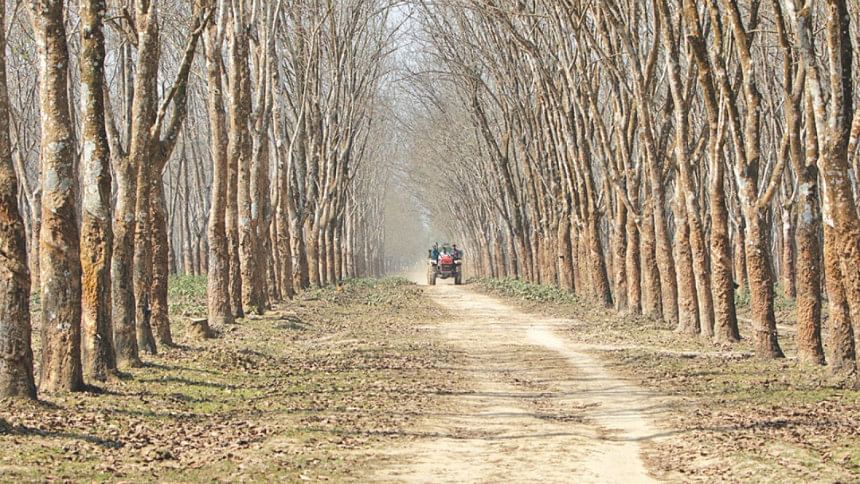
Rubber plantation in place of sal forest. Photo: Philip Gain
Sicilia Snal, aged 25 in 2006, was shot when she went to collect firewood in the forest near her village. Sicilia is a Garo woman of Uttar Rasulpur, in Madhupur sal forest area. It was early in the morning of August 21, 2006, that Sicilia went to collect firewood with a few other Garo women. On their way back, they put down their loads to take rest for a while. All of a sudden, to their great surprise, the forest guards fired shots from their guns. Sicilia was hit. She fell to the ground, unconscious and bleeding. Terrified all but one woman fled.
Then other villagers came to her rescue. She was immediately taken to Mymensingh Medical Hospital where she had a crude surgery and her gall bladder, plastered with many pellets, was removed. Some pellets remained in her kidney and around 100 pellets in the back of her body and hands—she has to live with these for the rest of her life.
Eleven years have passed since she was shot. The local Garos staged some protests and small humanitarian aid came to her family immediately after the assault. A case was also filed on her behalf. But the forest guards who fired the gun shots were never brought to justice. Nobody seriously moved with the case either.
Sicillia and other Garo women still go to the forests, their ancestral land, to collect firewood. Asked about the state of the case filed on her behalf Sicilia says in great frustration, “I know nothing about the case.” She believes the Forest Department and the Forest Guards are immune from legal action.
Before and after Sicilia was shot, a few killings and abuse of forestland in Madhupur made headlines in national and international newspapers. Notable among them was the killing of Piren Snal that left the Garos in terror. On January 3, 2004, the Garos organised a peaceful rally to evince their disdain against the so-called eco-park within the Madhupur National Park. While the Forest Department was desperate about fencing an area with concrete walls to demarcate the eco-park, the Garos saw it as a threat and an attempt to restrict their free movement in the forest they consider as their ancestral land.
The forest guards, with support from other security agencies, fired shots from their guns to disperse the rally. Hit by bullets, Piren Snal, a 28-year Garo youth from Joynagachha village, died on the spot. Utpol Nokrek, an 18-year youth then, was shot from the back, right into the spine that sent him to a wheel chair for the rest of his life.
The Madhupur sal forest is just one hotspot of abuses inflicted on forest villagers. The Chittagong Hill Tracts (CHT) is a vast forest landscape of Bangladesh that demonstrates serious abuses of all kinds done to the forest and forest people. Let me give the example of a small Chak forest village in Bandarban—and how the Chaks were eventually evicted from it.
It was in December 2008 that I first went to Badurjhiri, in Naikhongchhari upazila in Bandarban, which was, at the time, inhabited by 15 Chak families. Distinct from other ethnic communities in Bangladesh, this tiny Chak community lived for centuries in remote forest villages, satisfied with their traditional jum agriculture. Guided by a group of Chak men, we walked three and a half hours from Baishari Chak paras (hamlets) in Naikhongchhari upazila to reach Badurjhiri.
There had always been fears about invasion by Bangalees attracted to the land’s forest produce and encroachment of rubber and tobacco plantations by them, but Badurjhiri remained vibrant nonetheless, with crops that came from jum, pigs, fowls, and a rich variety of vegetables.
Going back to Badurjhiri in December 2010 was something of a shock. The rubber cultivators had expanded their boundaries towards Badurjhiri. The Chak men and women we walked with explained how the jungle continued to be cleared for rubber cultivation. In 2008, when we were passing through Amrajhiri, the jungle was being cleared in preparation for fresh rubber plantation. The nearby hills in the east, west, and south still had coverage of native forests. Two years later, we found out that the entire area had been cleared.
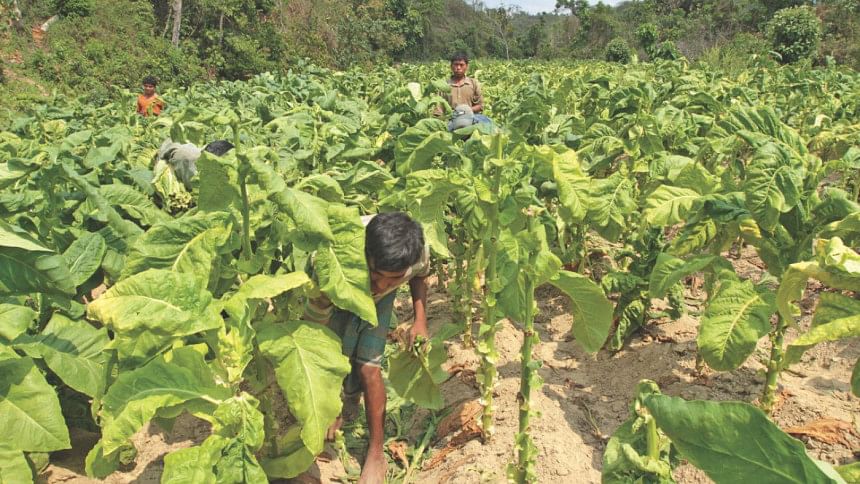
Commercial tobacco cultivation in Naikhhongchhari that is destructive for the forest. Photos: Philip Gain
Rubber cultivation was fast taking over their village, and the Chaks were afraid of what awaited them. They had witnessed how rubber plantation, among other reasons, had forced the Chaks of the neighbouring Longodujhiri (Khal) Chak Para to abandon their village. A Thoai Ching Chak, a villager, remarked, “If rubber cultivation spreads close to our village, we will surely be evicted.” He perhaps did not imagine that his fear would come true so soon.
They had to desert their village in April 2013.
Before the eviction, every time I would go to Badurjhiri, a group of Chak men and women would accompany me, but when I went back in 2013, they refused to go there. They told me horrific stories of attacks on them. On the night of March 19, 2013 the whole village was attacked by armed assailants in the dead of the night. For hours they stabbed and beat men and women, vandalised houses, slaughtered chickens (and loaded them in sacks), and looted belongings.
After the deadly attack, young girls and the wounded immediately left Badurjhiri. In April, almost all of the Chaks of Badurjhiri deserted the village. The 15 Chak families of Badurjhiri took shelter in four Chak villages in Baishari. They still live there.
Abuse, ill treatment and underlying factors
Abuses and ill treatment of the forest people—in Madhupur, Chittagong Hill Tracts (CHT), Khasi hamlets or other sal forest areas—are mere symptoms of underlying factors that have brought the forest to ruin. Officially, 18 percent of the country (2.6 million hectares) is public forestland—landmass recorded as forestland when the Forest Act of 1927 came into being. But in reality, approximately 6 percent is said to be covered by forests. This includes the mangroves and plantations covering 403,458 hectares since 1873. According to the Forest Department estimate, it now controls only 10.3 percent of the land surface (Forest Department 2001).
The largest category of forests in Bangladesh is reserved forests, which include the Sundarbans in the southwest (601,700ha), and forests in the CHT region in the southeast (322,331ha) and the Madhupur tracts in the north-central region (17,107ha). A much smaller category is the protected forests. Privately owned forests are another category, which range from plantations to those that are wholly owned by private individuals or companies. The last category of forests is unclassed state forests (USF), most of which is in the CHT.
 Hills cleared for rubber plantations. Photos: Philip Gain
The relationship between people living in and around the forests is intimate—reciprocal and spiritual. The life and culture of the forest communities centre around the forests and the forest ecology. Their sustenance is dependent on the forest and therefore they do what they can to protect it. They are the “children of the forest” in the truest sense. To them civilisation and culture are inexorably connected with land, ecology and nature. It wasn’t too long ago that most of the indigenous peoples of Bangladesh lived in forests. Many factors, including actions taken by the state, have led to the massive destruction of the forest, and dispossessed forest communities of their land.
Reservation of the forests, beginning in the days of British colonial rule, has greatly curbed the rights of different indigenous communities to the land and the forests. In the CHT, about a quarter of the land was declared reserved forest during the British colonial era, severely limiting access of the indigenous communities to the land that had been their commons for centuries. Reservation of forest continues to date.
The local communities consider the expansion of the reserved forests as an immoral act. It dispossesses them of the means of their livelihood, and does immense harm to biodiversity and to knowledge production about medicinal plants of the local indigenous communities. The expansion of reserved forests, mainly for plantations, financed by international financial institutions (IFIs) and donors, has further muddied the waters when it comes to questions about land and ecology in the CHT, Madhupur and elsewhere.
Monoculture plantation has been the single biggest threat to the native forests in the hills as well as in the plains, affecting the life and livelihood of the forest-dependent communities. Plantations in Bangladesh include pulpwood (in the CHT), rubber, agroforestry, woodlot (for the production of fuelwood), teak, pine, etc. It is mainly the Forest Department and Bangladesh Forest Industries Development Corporation (BFIDC) that carry out the plantations on public forestland, mostly in the CHT, Chittagong, Cox’s Bazar, Sylhet and the sal forests. The IFIs—ADB and World Bank—funded most of these recent plantations.
The negative multiplier effects of manmade forest or plantations are quite similar around the globe. This is best illustrated in the words of Patricia Marchak (in her book, Logging the Globe, 1995), a Canadian scholar: “Plantations are monoculture, and the lack of biodiversity is of concern. They typically have sparse canopies and so do not protect the land; they cause air temperatures to rise, and they deplete, rather than increase, the water-table. They are generally exotic to regions. While the initial planting may be free of natural pests and diseases, that situation will not last, and plantation regions may not be in the position to combat scourges yet to arrive.”
When we look at the plantations on our public forestland, Patricia Marchak’s contention begins to make sense. It is possible to plant trees but it is impossible to create a forest. Hundreds of species of trees and bushes and a large number of other vegetable species grow on the forest floor. The knowledge of the forest-dwelling communities, their traditions, culture, history, education are all part of the forest. And now, all this has been seriously affected.
 Mountains after mountains have been cleared in Bandarban like this for preparation of rubber plantations. Photo: Philip Gain
The displacement of human communities is another consequence of a plantation economy. In the CHT, pulpwood and other industrial plantations (including rubber and tobacco) have displaced human communities (jumias in particular) who have lived in the forests for centuries. The eviction of the Chaks from Badurjhiri and Longodujhiri in Bandarban is a clear pointer to the effects of plantation on forest villagers.
Ecological damage caused by rubber plantation and the so-called social or community forestry on public forestland is another concern. Although a rubber plantation looks green, it is a desert for other plant species, birds and wildlife. It brings in some cash for the government and private entrepreneurs, and misery and trouble for the local communities.
Vast expanses of banana, pineapple, papaya and spice plantations that we see in Madhupur sal forest can have far-reaching effects on the soil, seeds, wildlife, and human health. The trade in chemical pesticides, fertilisers and hormones related to it is huge.
Plantations provide ample ground to land grabbers to illegally convert the forestland to agricultural land. And it is the rich, the influential and the outsiders who encroach upon forestlands in collusion with government agencies and political forces. Banana plantations, illegally established on a massive scale on the forestland in Madhupur, are an example of how the plantation economy gives outsiders an opportunity to encroach upon public forestland. It is primarily the rich and the politically influential who control banana cultivation and benefit from it.
Aside from the plantations carried out with foreign funds (both loans and grants), state-sponsored and aid-dependent ‘development’ initiatives from the Pakistan era have had devastating consequences for the land and forests in the CHT. During the Pakistan regime, two development interventions of the state, Karnaphuli Paper Mill (KPM) and the Kaptai Hydroelectric Project, were a matter of “national pride”. But the projects caused unprecedented ecological damage from the start and posed the biggest threat to the indigenous peoples of the hills and their economic, aesthetic, and political life.
Is there a fix?
It is in the best interests of the nation and its people that whatever is left of the native forests in Bangladesh is protected from the onslaught brought about by monoculture plantation and human greed. Given all the damage done to the forests since colonial times, a natural fix is difficult to come by. However, if there is any hope of protecting what little is left, all actors, particularly the government agencies and donors, must recognise the underlying factors that have ruined the forest(s), especially the plantation economy and development initiatives taking place on forestland.
The surviving forest patches of Bangladesh are still so rich that the seeds and coppices would easily regenerate a degraded forest. A mature sal tree in any sal forest patch, for example, produces thousands of seeds in a season alone which can be planted for its expansion.
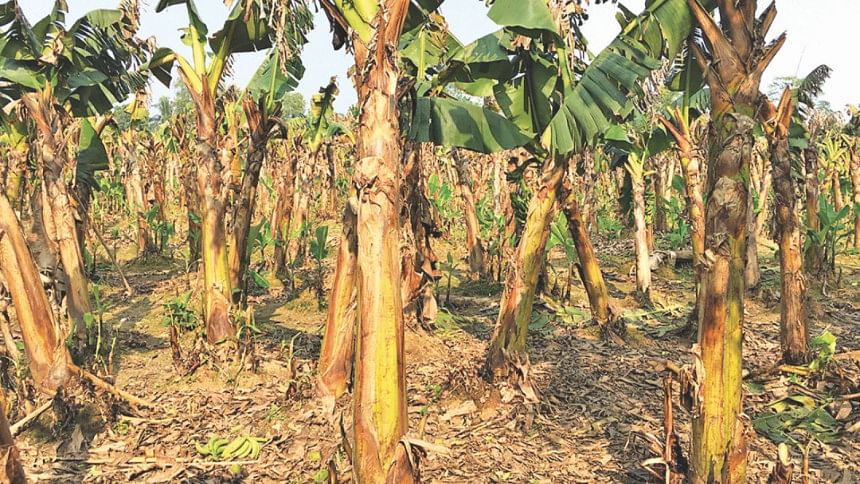
Banana plantations that have ruined much of sal forests to the core. Photo: Philip Gain
The sal forests in Madhupur and elsewhere provide an environment conducive for hundreds of other species of plants and life forms to grow. Professor Salar Khan (late) who guided the National Herbarium for many years requested the Forest Department not to plant exotic species to create monoculture in a place home to hundreds of native species. He tried to convince the department that the consequence of single species plantation is the destruction of genetic resources that the sal forest had sustained. He was ignored. He consistently requested the Forest Department to protect the remaining sal forests and replant wherever possible. ADB’s withdrawal from funding any forestry project in Bangladesh since 2007 is evidence that Professor Salar Khan was right. The World Bank’s funding in the forestry sector is reportedly limited.
In the CHT a hill left untouched for some years becomes green with myriad native species. In an abandoned jum plot in the CHT, countless native species appear and spread throughout the plot only in a few years. But a hill, planted with teak, pulpwood or other industrial monoculture, is likely to be ruined. Plantation is a manmade disaster that needs to be prevented in any forestland that has a chance to regenerate. However, “complex” or mixed plantation can be an option in areas that are truly degraded. Even in that situation there is no need for exotic species; there is plenty of local species.
Wrongs done to the forests and forest-dwelling communities need to be righted if justice is to be done. For that to happen, both forest and forest-dependent communities must be given protection. We should not forget the warning of Chandi Prashad Bhatt who said: “Unless we find a framework in which forests and people can live together, one or the other will be destroyed.”
Philip Gain is a researcher and the director of Society for Environment and Human Development (SEHD). He has been reporting, writing and filming on Madhupur sal forest, the Chittagong Hill Tracts and forest people since 1986.